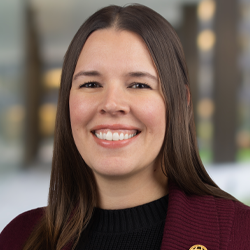
Executive Officer, Montana Board of Nursing
As a registered nurse for the past 20 years, I have had the privilege of working as a staff nurse on a progressive care unit, a clinical nurse for a group of cardiothoracic surgeons, a cardiac clinical trials research nurse, a quality assurance nurse, creator of a pre-operative clinic, and now for eight years, a complete change of setting to take on the role as executive officer (EO) of the Montana Board of Nursing. As an EO at an umbrella agency where resources are quite finite, I’ve also served as EO for other professions including respiratory care practitioners and hearing aid dispensers. Included in my role as EO for nursing in Montana, I also function as a practice consultant for all levels of licensure and as the education consultant for all of our nursing programs. This past year, I've also temporarily filled the role of administrator for our multi-board alternative to discipline program. One of my most prioritized and loved opportunities in this role is that I have the privilege of having a manageable-enough number of programs that I can get face time with each graduating class to talk not just about how one applies for a license, but also describe what it means to hold a license in our state and how important it is to utilize the resources that are available to provide safe and competent care.

During my eight years as EO, I've had the pleasure of chairing the NLC policy committee for six years, serving on the NLC executive committee for four years, and for the past two years, serving as director-at-large on the NCSBN Board of Directors.
Walking into my first NCSBN Annual meeting, which was in 2018 – the 40th anniversary, I had six weeks of experience in nursing regulation. I became acutely aware of where I fell on the novice to expert spectrum (below novice!) and recognized how much I had to learn about this EO role as I listened to the various speakers and observed the methodical meeting practices that I’ve come to appreciate during subsequent NCSBN meetings. While the first meeting experience was intimidating, it was also an incredible introduction to the many, many resources that NCSBN has invested in to set every single member jurisdiction up for success in regulating the practice of nursing. And I’m not only referencing the investment in research and robust exam design, but also people development and leadership succession. So many individuals, from NCSBN staff to other EOs and even staff at other boards, have invested their time and knowledge into my development and helped guide me to be competent and even sometimes proficient in this EO role. This investment into my personal and regulatory development from so many has given me the characteristics I believe are necessary to fulfil my responsibilities as a director on the board: the willingness and confidence to ask questions and contribute to conversation, an understanding of the many resources that exist and the ability to assess what might still be needed or is missing, awareness that differing perspectives should be embraced and may bring about a greater solution and an appreciation for the work of so many who have gone before and will come after.
One of the aspects of this statement that I so appreciate as a nursing regulator in my own state is the partnership I feel from NCSBN in their embrace of our shared mission of protecting the public. There is a significant synergy we benefit from as individual boards and colleges of nursing in partnering with the Council that we would not gain even from partnering amongst ourselves. To me, this strategic statement is what drives us to One NCSBN – it’s a cyclical statement – “we protect the public and the trust in nursing” by investing in staff, research, item writing, and security to have a state of the art licensing exam that measures entry level competence. Why do we want to measure entry level competence? To “protect the public and the trust in nursing”. “We protect the public and trust in nursing” by investing in the infrastructure and maintenance that allows NRBs to contribute to national licensing databases that promote the sharing of critical information about individual jurisdictions’ licensees. Why do we want accessible licensee databases? To “protect the public and trust in nursing”. I think boiling the statement down in this simplistic way helps clarify how I would contribute to the achievement of this statement – in fulfilling my fiduciary responsibilities the two protect objectives must be met – public and nursing. When we ensure both objectives can be met, we can drive the mission of the organization in the right direction on any decision the board is asked to make.